Meta is preparing to charge consumers for artificial intelligence in a break with its traditional business model. Internal discussions have put a premium tier for its forthcoming AI agent at $199.99, with a $20 monthly option also in play, according to The Information's latest podcast.
The pricing is unsettled. The direction is not. Meta now treats AI as something users might buy, rather than a feature that makes Facebook and Instagram stickier.
A second revenue line beside advertising
Meta has accelerated releases this year, with Muse Spark and Muse code arriving in quick succession. The agent is the first of those products conceived as a purchase rather than an upgrade.
The company sold paid Meta AI subscriptions on Instagram and WhatsApp earlier this year. A standalone agent at $199.99 is a different proposition. It puts subscription income beside advertising and offers a route to recovering the capital sunk into AI infrastructure.
Meta has spent at scale on chips and data centres, and investors have grown restive about returns. A consumer subscription answers that question in a way advertising uplift cannot, because it is measurable from day one.
An agent modelled on Claude
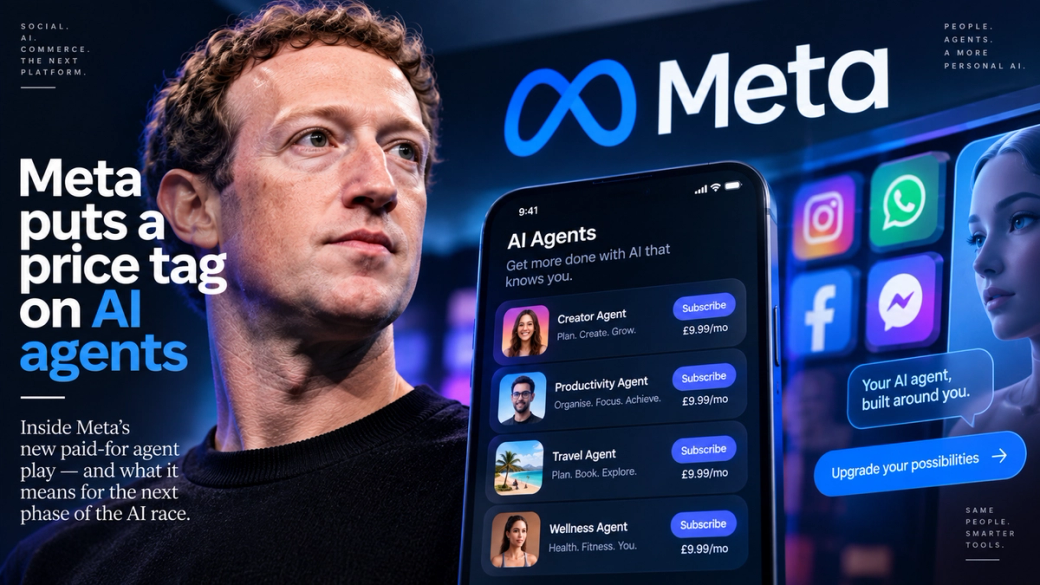
The agent is being trained in secure environments to reach sites including DoorDash, Etsy, Reddit and Outlook. It is designed to act for the user, scheduling emails or ordering food. Early prototypes show a dashboard of skills, among them fitness trackers and travel itineraries. The interface follows Anthropic's Claude.
Release is targeted for late August or early September. The borrowed design tells its own story. Meta is competing on agent capability, ground held by Anthropic and OpenAI, rather than on the distribution advantage it usually leans on.
Nothing in the described feature set is unavailable elsewhere. Task execution across consumer sites, a skills dashboard, itinerary building: rivals ship all of it. Meta's case has to rest on execution or price, and $199.99 rules out price.
Own models, many apps
An October release is planned for a model known inside the company as watermelon, expected to carry the Muse Spark 1.3 badge. Future agents will run on Meta's own models, a shift from reports that it would lean on Anthropic until its internal systems matured.
Meta intends to ship many small apps rather than one interface. Mark Zuckerberg has said AI lets smaller teams build faster, which allows experiments that do not threaten the advertising core. Products that gain traction get more resources. The rest are left behind.
The strategy fits a company with cash to spare and little to lose from failed launches. The pricing does not. At $199.99, Meta would be asking consumers to pay a premium for a product whose design it has borrowed, and whose category it entered late.